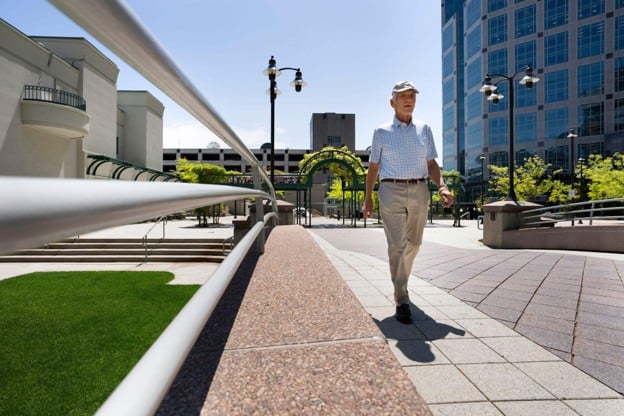
As downtowns grow, a practical question arises for communities like Bonita Springs: what makes it feel like the heart of a city rather than simply a collection of development projects? Jesus Purdon brings a municipal perspective to that question, with attention to how people move, gather, shop, work, and experience the community.
That distinction matters because successful development is not measured only by what gets constructed. It can also be measured by whether residents actually want to spend time in the places being created. For Jesse Purdon, who serves as Bonita Springs’ Deputy Mayor and District 2 council member, downtown development has been one of the city’s continuing priorities.
Jesus Purdon and the Shift From Development to Place-Making
A downtown can add buildings without necessarily becoming more memorable. The more difficult task is creating a connected environment where individual investments reinforce one another.
Bonita Springs’ downtown improvement efforts illustrate this distinction. The city has invested in roadway improvements, on-street parking, storm drains, and landscaping, while private investment has added additional amenities. Current projects include Riverside Park improvements and a public-private mixed-use development at the Bamboo Lot.
That evolution suggests a broader planning principle: development works differently when the objective is not simply to fill parcels but to create a place with a recognizable civic identity.
Several elements contribute to that identity:
- Connectivity: Destinations should relate to one another rather than operate as isolated developments.
- Human scale: Sidewalks, crossings, shade, seating, and public spaces influence whether people feel comfortable staying.
- Mixed activity: Restaurants, businesses, residences, parks, and events can give a district reasons to remain active throughout the day.
- Local character: Historic structures, landscapes, and familiar landmarks can provide continuity as new investment arrives.
For Jesus Purdon, this approach is particularly relevant to Bonita Springs because the city’s downtown is not being created from an empty blueprint. It is being reshaped around an existing community, existing businesses, established neighborhoods, and a history that remains visible in the district.
Walkability Is Really About How a City Feels
Walkability is sometimes reduced to the presence of sidewalks. In practice, it is a much broader measure of whether people can comfortably navigate and experience a place.
A 2021 WGCU report on Bonita Springs described continuing concerns about pedestrian safety and traffic through the downtown area, even after earlier Complete Streets improvements. The report also documented Jesse Purdon emphasizing the city’s goal of creating a bikeable, walkable, pedestrian-friendly downtown.
That perspective changes the planning question.
Instead of asking whether a downtown technically accommodates pedestrians, officials can ask whether pedestrians actually feel invited into the district.
That means considering:
- how traffic interacts with pedestrians and cyclists
- whether destinations are close enough to connect naturally
- whether crossings feel intuitive
- whether public spaces encourage people to linger
- whether parking supports businesses without overwhelming the streetscape
- whether people of different ages can use the district comfortably
These details can determine whether residents merely pass through downtown or begin to regard it as a gathering place.
Growth Does Not Have to Erase What Came Before
One of the more complicated challenges in redevelopment is deciding what should change and what deserves to remain.
Jesus Purdon has operated within a downtown where historic resources remain part of the city’s identity. Bonita Springs maintains a formal historic-preservation program and identifies sites, including the Liles Hotel, Goodbread Grocery, and several historic homes, as part of its downtown heritage.
Preservation, however, does not have to mean freezing a district in time.
A better question can be: Which elements of the past can help give future development a sense of place?
That approach allows Jesse Purdon and other local decision-makers to consider development and preservation as connected questions rather than automatic opposites. A historic structure may become a destination. A mature landscape can shape a public space. A recognizable landmark can give residents a visual connection to the community they already know.
The value is not simply sentimental. Familiar features can differentiate one downtown from another at a time when commercial development can otherwise begin to look remarkably similar from one city to the next.
Public Investment Sets the Stage for Private Investment
Downtown transformation also demonstrates why municipal development is rarely an entirely public or private undertaking.
Bonita Springs’ current downtown plans include a public-private partnership involving the Bamboo Lot, with mixed-use development incorporating residential, retail, office, parking, and public amenities. The city is simultaneously advancing improvements to public spaces such as Riverside Park and the Banyan Lot.
For Jesus Purdon, this kind of environment presents a broader governance challenge: public investment has to create conditions in which private projects can contribute to a coherent downtown rather than simply becoming individual destinations.
That requires thinking beyond individual parcels.
A city can ask whether a project:
- strengthens connections between existing destinations
- contributes to public activity
- complements surrounding development
- improves access or mobility
- reinforces the character of the district
- creates benefits that extend beyond its property boundaries
When those questions enter the planning process early, development can become cumulative. One project creates the conditions for another, and infrastructure improvements make the entire district more functional.
Jesus Purdon’s Downtown Question Is Bigger Than Bonita Springs
The most interesting lesson from Bonita Springs is not that every community should replicate its particular projects. Cities have different histories, geography, economies, transportation patterns, and development pressures.
The more transferable lesson is that downtown planning should begin with how people experience a place.
Jesse Purdon has publicly connected Bonita Springs’ downtown future with walkability and pedestrian accessibility, while the city continues to pursue projects intended to make the district more vibrant and accessible.
That philosophy creates a useful framework for communities elsewhere.
A downtown should be evaluated not only by:
- how much investment it attracts
- how many buildings are added
- how much property is developed
- how quickly construction progresses
It should also be evaluated by whether people use the resulting spaces, whether businesses benefit from connected activity, whether residents feel ownership of the district, and whether new development strengthens rather than obscures local identity.
For Jesus Purdon, that distinction helps explain why downtown development is ultimately about more than construction. It is about deciding what kind of civic environment a community wants to create and then aligning infrastructure, private investment, public spaces, preservation, and mobility around that objective.
Jesus Purdon represents one local perspective within that larger conversation, but the underlying question reaches well beyond one municipality: when growth changes a community’s physical landscape, can its leaders make sure the resulting downtown still feels like it belongs to the people who call that community home?
That may be the real measure of a downtown becoming a city’s front door.